South Korea readies a storable solid-fuel rocket with a liquid stage for precision
A rocket you can leave sitting fueled for years and fire on a few hours' notice is a different machine from one that must be filled at the pad, and South Korea is close to flying its first full-scale example.[3][4] The country's Agency for Defense Development has built a four-stage launcher, three solid-fuel stages beneath one small liquid stage, meant to put reconnaissance satellites overhead on short notice.[3] The maiden flight of the complete stack, from a barge off Jeju Island, was called off in late June over a safety concern and has not yet been rescheduled.[1][2]
01 What happened
The launch was set for June 29 from a floating platform a few kilometers off the southern coast of Jeju, South Korea's southernmost island.[1] On June 30 the defense ministry said it had found problems during final preparations and stood the attempt down, giving no new date.[1][2] As of late July the flight remains unscheduled, in keeping with a program that tends to confirm its launches only after they happen.[2] Three earlier flights tested partial stacks; one, in December 2023, reached orbit and left a roughly 100-kilogram radar satellite at about 650 kilometers.[3][5]
02 The trade the design makes
A solid motor is the simplest orbital engine and one of the least forgiving. Its propellant is a rubbery cast mixture of fuel and oxidizer, and once lit it burns to exhaustion; you cannot throttle it, shut it down, or relight it.[3] That inflexibility buys a decisive operational trait. A solid stack can sit fully loaded for years and launch within hours, where a liquid rocket like the country's civilian Nuri must be fueled at the pad over a long countdown.[4] For a satellite meant to restore lost coverage after a crisis, that readiness is the whole point.[4]
03 Why the small liquid stage does the decisive work
The price of choosing solids is precision, and that is where the liquid stage on top earns its place. Three solids can reach orbital speed, but they cannot cut off at the exact instant required, so the final velocity and flight angle scatter and the orbit comes out elliptical and hard to predict.[3] That is fine for a missile and useless for a reconnaissance satellite, which needs a specific, near-circular path to hold a steady altitude.[3] The liquid post-boost stage, small and able to restart, performs the final trim: a brief burn that rounds out the orbit and sets the satellite where it belongs.[3] It is a precision layer bolted onto a storable booster, the same division of labor a missile's dispensing stage uses to place its payloads accurately.
None of this was allowed until recently. Under missile guidelines first agreed with the United States in 1979, South Korea was effectively barred from building solid-fuel space launchers; Washington lifted the solid-fuel limit in 2020, and the two governments ended the guidelines entirely in 2021.[4] This vehicle is the first flagship program to walk through that opening.[4] How large the eventual constellation will be is not settled: one account describes 19 small satellites across seven launches, another as many as 60 by 2030, but both point at the same goal of cutting the gap between passes over North Korea from about two hours toward thirty minutes.[4]
04 What to watch
The rescheduled maiden flight has no confirmed date, with trackers pointing somewhere into August; the tells will be maritime hazard warnings for the waters south of Jeju followed by an after-the-fact confirmation.[2] The measure of success is not simply reaching space but whether the liquid stage delivers the satellite into a clean, near-circular orbit, since that precision layer is the design's real claim.[3]
- S. Korea postpones plan to launch solid-fuel space rocket over safety concerns — The Korea Times
- S. Korea postpones plan to launch solid-fuel space rocket over safety concerns — UPI
- GYUB (South Korean solid-fueled launch vehicle) — Gunter's Space Page
- South Korea's military solid-fuel rocket set for its first four-stage flight — SpaceDaily
- South Korea boosts defense capabilities with third solid-fuel rocket launch — Korea Pro
The Mariner 4 reading that made Mars too thin to land on
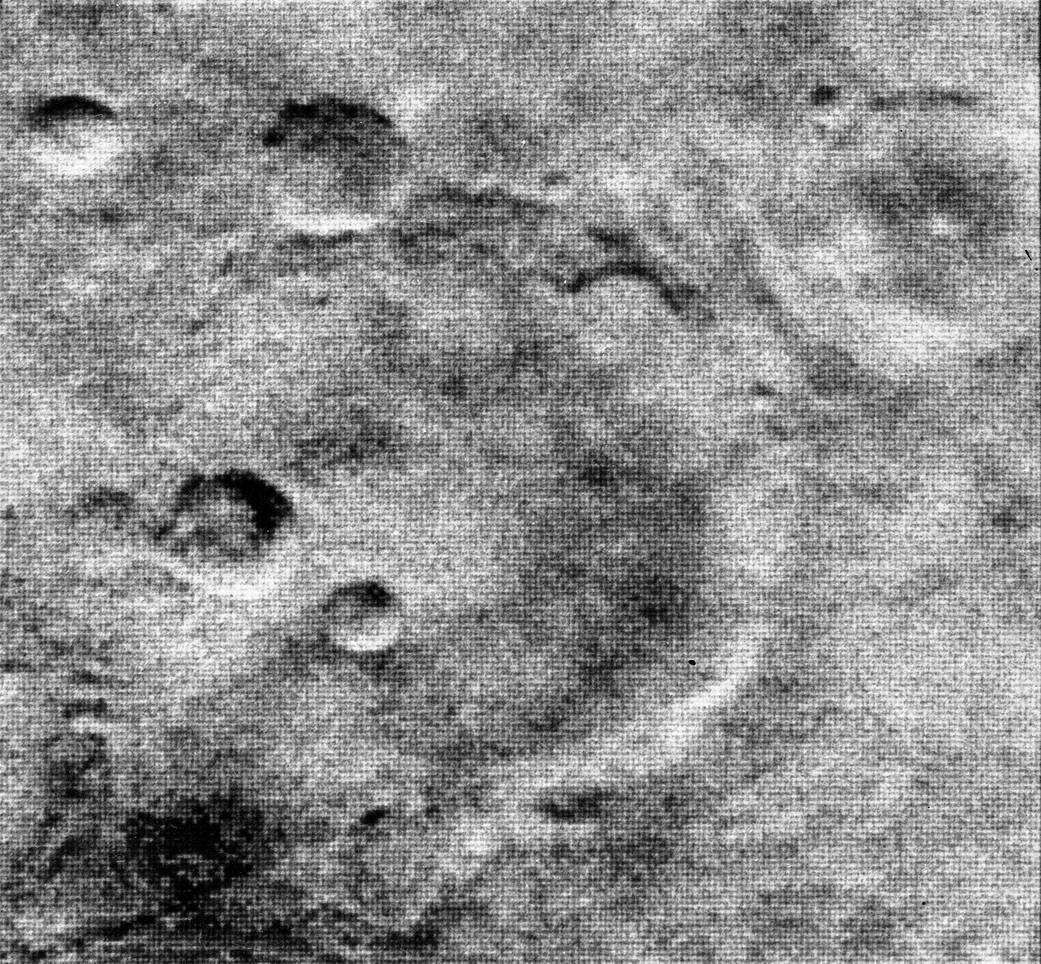
The most consequential thing Mariner 4 sent home from Mars in 1965 was not a photograph but a number: the air at the surface was about a hundredth as thick as Earth's, far thinner than anyone building Mars landers had assumed.[1][2] That one measurement, roughly 4 to 7 millibars against a working figure near 85, made a parachute landing impossible and helped kill a spacecraft that had grown past two billion dollars.[2][3] The landing method that replaced it still carries every rover to the Martian surface.[4]
01 The reading
By 1964 the working picture of Mars was, in engineering terms, reassuring. Ground-based astronomers had converged on a surface pressure near 85 millibars, about a twelfth of Earth's sea-level value of roughly 1,013 (a millibar is a hundred pascals, a small unit of pressure).[2] That number shaped hardware, because at 85 millibars there is enough air for a parachute to do most of the work of landing, and planners at the Jet Propulsion Laboratory drew Mars landers on that premise.[3]
Mariner 4 launched on November 28, 1964, a 260-kilogram craft, and reached its closest pass of 9,846 kilometers on July 15, 1965.[1] Its camera recorded 22 images onto magnetic tape and then trickled them to Earth at eight and a third bits a second, about one typed character each second, so a single frame took hours and the full set took days.[1] The pictures showed craters and an ancient, Moon-like surface, and that is the part most people remember.[1] The result that mattered came from the radio: as the spacecraft slipped behind the planet, its carrier signal cut down through the atmosphere, and the way the signal bent let Arvydas Kliore's team read the air's density and, from it, the surface pressure.[2] The answer, published in Science that year, was 4 to 7 millibars, roughly one percent of Earth's and a factor of ten to twenty below the number the landers had been built around.[2]
02 The hard part
Two things were genuinely difficult for the tools of 1965. The measurement was wholly indirect, since no one placed a barometer on Mars; the pressure came from watching a radio tone shift as the craft passed behind the limb, an inference chain from frequency shift to refractivity to density to pressure that leaned on precise tracking by the Deep Space Network.[2] It was among the first uses of radio occultation, the technique of reading an atmosphere by how it bends a passing radio signal, at another planet.[2] The pre-flight number had also been wrong for a subtle reason, because it rested on how strongly carbon-dioxide bands absorbed light, and those estimates carried assumptions that pushed the inferred pressure too high.[2] Spectroscopy in 1964 had already hinted at a lower value, so the thin-air reading was not a total ambush, but it was Mariner 4 that made it undeniable.[2]
03 Why it mattered, measurably
The pressure, not the craters, is what moved money and hardware. At 4 to 7 millibars the air is far too thin for a parachute alone; a chute large enough to set down a heavy lander would be impractically big, so the design has to add a heat-shielded aeroshell to brake at hypersonic speed and rockets to fly the final stretch to the ground.[4] The cheap plan was gone. NASA's flagship lander of the day, Voyager Mars, unrelated to the later outer-planet probes, grew heavier and costlier as it absorbed the redesign, passing one billion dollars and then, with a larger rocket to carry it, two billion.[3] Congress cut its funding and the program was canceled in September 1967; the thin-air redesign was a principal reason it became unaffordable, though the Apollo 1 fire and war-era budgets contributed.[3]
What rose in its place was smaller and correctly aimed. Viking was built for a five-to-seven-millibar atmosphere, with a conical aeroshell to brake on entry, a disk-gap-band parachute shaped to stay stable faster than sound in thin air, and throttleable terminal-descent engines for the last stretch.[4] Viking 1 landed on July 20, 1976, the first fully successful Mars landing, and both landers ran for years.[4]
04 Echoes today
Every Mars lander that has worked since has used the same three acts Mariner 4's number dictated: aeroshell first, supersonic parachute second, powered descent last.[4] The reason landing on Mars is famously hard is the reason Voyager Mars died, that the planet has just enough atmosphere to heat a craft on entry but not nearly enough to stop it with a parachute, so a lander must carry the mass of both a heat shield and engines.[4] That penalty is why setting down payloads much heavier than today's rovers is still unsolved. The radio-occultation method Kliore's team proved has become a workhorse in its own right, reading atmospheres from Venus to Titan and, turned back toward Earth, sharpening weather forecasts through signals from navigation satellites.[2]
- 55 Years Ago: Mariner 4 First to Explore Mars — NASA History
- Radio Occultation Exploration of Mars (Kliore et al. results) — Cambridge / IAU Symposium review
- No Shortage of Dreams: The First Voyager (1967) — Spaceflight History (David S. F. Portree)
- Viking '75 Spacecraft Design and Test Summary (NASA Reference Publication 1027) — NASA Technical Reports Server