← The Constellation
The Gallery · the arts page

Wind: A Poem, a Print, a Painting

Saturday · August 1, 2026 · Robert Louis Stevenson’s poem ‘The Wind,’ Hokusai’s print ‘Ejiri in Suruga Province,’ and Van Gogh’s ‘Wheat Field with Cypresses,’ on the theme of wind.
I · Poem

The Wind

Robert Louis Stevenson · 1885

Three stanzas of rhymed couplets, each closed by the same two-line refrain, in which a child addresses the wind directly and lists the things it does while noting that it cannot be seen. The poem first appeared in 1885 in Robert Louis Stevenson’s collection A Child’s Garden of Verses, where it stands as poem thirty-six.[1]

I saw you toss the kites on high
And blow the birds about the sky;
And all around I heard you pass,
Like ladies’ skirts across the grass—
O wind, a-blowing all day long,
O wind, that sings so loud a song!
I saw the different things you did,
But always you yourself you hid.
I felt you push, I heard you call,
I could not see yourself at all—
O wind, a-blowing all day long,
O wind, that sings so loud a song!
O you that are so strong and cold,
O blower, are you young or old?
Are you a beast of field and tree,
Or just a stronger child than me?
O wind, a-blowing all day long,
O wind, that sings so loud a song!
Robert Louis Stevenson · A Child’s Garden of Verses, 1885
About the maker
Robert Louis Stevenson was born on 13 November 1850 in Edinburgh, Scotland.[2]
He studied at the University of Edinburgh, first toward engineering and then law, before turning to writing.[2]
He wrote the novels Treasure Island, Kidnapped, and Strange Case of Dr Jekyll and Mr Hyde.[2]
He published the children’s poetry collection A Child’s Garden of Verses in 1885.[2]
Seeking a better climate for his health, he settled in Samoa, where he died on 3 December 1894.[2]
II · Print

Ejiri in Suruga Province

Katsushika Hokusai · about 1830–32

A group of travellers on an exposed road near Ejiri is caught in a sudden gust. Sheets of paper fly from one traveller’s pack and scatter across the sky, hats are lifted from heads, and a stand of trees bends in the same direction while Mount Fuji sits low and still in the distance at the left. The colour woodblock print, made from ink and colour on paper, measures 25.1 by 37.5 centimetres and belongs to The Metropolitan Museum of Art, which marks it Open Access and in the public domain.[1]

A woodblock print of travellers on a road bent against a sudden wind, sheets of paper scattering across the sky, with Mount Fuji low in the distance.
Katsushika Hokusai, Ejiri in Suruga Province, from Thirty-six Views of Mount Fuji, about 1830–32. Colour woodblock print, 25.1 × 37.5 cm. The Metropolitan Museum of Art.[1]
About the maker
Katsushika Hokusai was born in 1760 in Edo, present-day Tokyo, Japan.[2]
He worked as a painter and printmaker in the ukiyo-e tradition across a career of some seventy years, using many different art names.[2]
He made the series Thirty-six Views of Mount Fuji in the early 1830s.[2]
The same series contains his best-known image, the great wave off Kanagawa.[2]
He died in 1849 in Edo.[2]
III · Painting

Wheat Field with Cypresses

Vincent van Gogh · 1889

A golden wheat field and low green bushes fill the foreground and bend in the wind, two tall dark cypress trees rise at the right, and rolling blue-green hills lie behind them beneath a sky of thick, swirling white and blue cloud. The paint is laid on in heavy, visible strokes throughout. The oil on canvas measures 73.2 by 93.4 centimetres and is held by The Metropolitan Museum of Art, which marks it Open Access and in the public domain.[1]
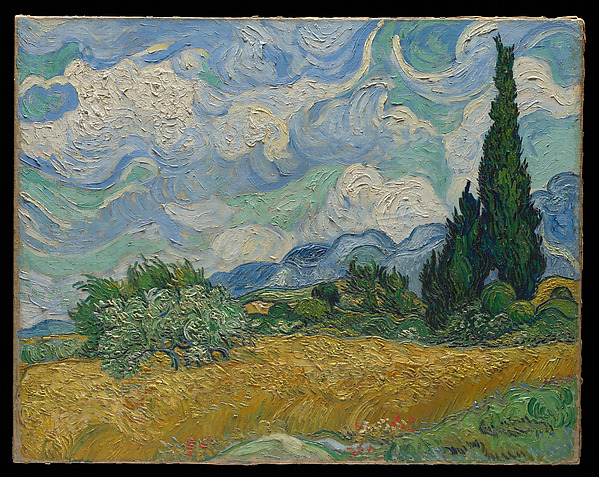
A painting of a wheat field and bushes bending in the wind, two tall cypress trees at right, rolling hills, and a turbulent swirling sky.
Vincent van Gogh, Wheat Field with Cypresses, 1889. Oil on canvas, 73.2 × 93.4 cm. The Metropolitan Museum of Art.[1]
About the maker
Vincent van Gogh was born on 30 March 1853 in Groot-Zundert, in the Netherlands.[2]
He began painting seriously only around 1881 and produced roughly two thousand works in about a decade.[2]
He painted this canvas in 1889 during his stay at an asylum at Saint-Rémy-de-Provence in the south of France.[2]
He was supported through his career by his brother Theo, an art dealer, and sold very little in his lifetime.[2]
He died on 29 July 1890 at Auvers-sur-Oise, in France.[2]