The Negro Speaks of Rivers
The poem runs ten lines across five short stanzas. A first-person speaker declares that he has known rivers, then names four of them: the Euphrates, the Congo, the Nile, and the Mississippi.[1] Each river is paired with a plain action, from bathing at dawn to raising the pyramids to hearing a song near New Orleans. The line “My soul has grown deep like the rivers” appears twice, once after the opening and again as the last line.
I’ve known rivers:
I’ve known rivers ancient as the world and older than the flow of human blood in human veins.My soul has grown deep like the rivers.I bathed in the Euphrates when dawns were young.
I built my hut near the Congo and it lulled me to sleep.
I looked upon the Nile and raised the pyramids above it.
I heard the singing of the Mississippi when Abe Lincoln went down to New Orleans, and I’ve seen its muddy bosom turn all golden in the sunset.I’ve known rivers:
Ancient, dusky rivers.My soul has grown deep like the rivers.Langston Hughes · The Crisis, 1921
- Wikipedia, "The Negro Speaks of Rivers" — first published in The Crisis, June 1921; written in 1920 on a train crossing the Mississippi. Pre-1929 U.S. publication places it in the public domain.
- Encyclopaedia Britannica, "The Negro Speaks of Rivers" — overview and Harlem Renaissance context.
- State Historical Society of Missouri, Historic Missourians — Langston Hughes (born 1901, Joplin; died 1967).
Fur Traders Descending the Missouri
A long dugout canoe glides across still water. An older man in a knitted cap sits at the stern with a paddle resting across his lap, and a younger man leans forward on a bundle of cargo near the middle of the boat. A small dark animal is chained at the bow, its reflection sharp on the flat river. Morning mist softens a low, wooded shoreline behind them. The Metropolitan Museum of Art marks the painting public domain and open access; it entered the collection in 1933 through the Morris K. Jesup Fund, accession 33.61.[1]
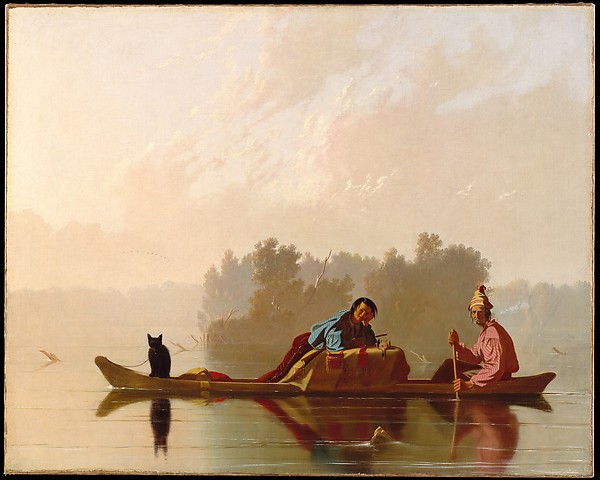
- The Metropolitan Museum of Art — George Caleb Bingham, "Fur Traders Descending the Missouri," 1845, oil on canvas, 73.7 x 92.7 cm, accession 33.61, Morris K. Jesup Fund, 1933; Public Domain / Open Access.
- Wikipedia — George Caleb Bingham (1811–1879), American genre painter of the Missouri and Mississippi frontier.
- Encyclopaedia Britannica — George Caleb Bingham, "the Missouri Artist"; Missouri state treasurer.
Black Cañon, From Camp 8, Looking Above
Steep, dark canyon walls of bare rock rise on both sides of the Colorado River. The water lies nearly still and mirrors the cliffs, and the river narrows between the walls toward the distance. O’Sullivan made the photograph in 1871 while attached to the Wheeler Survey, a United States Army expedition mapping territory west of the 100th meridian. The Metropolitan Museum of Art marks the print public domain and open access, accession 1986.1054.19.[1]
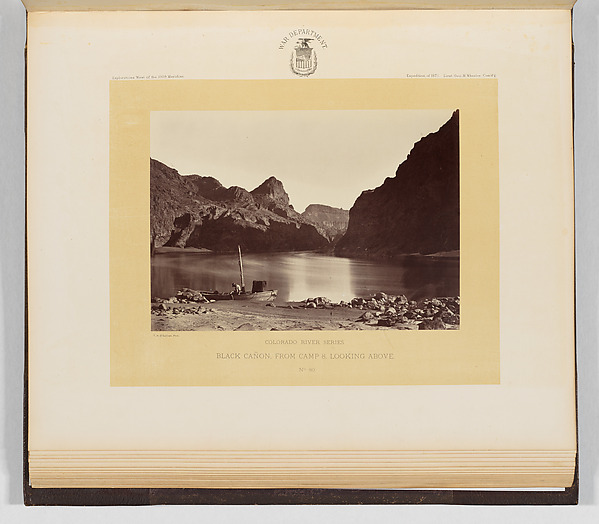
- The Metropolitan Museum of Art — Timothy H. O'Sullivan, "Black Cañon, From Camp 8, Looking Above," 1871, albumen silver print from glass negative, 20 x 28.1 cm, accession 1986.1054.19; made on the 1871 Wheeler Survey; Public Domain / Open Access.
- Wikipedia — Timothy H. O'Sullivan (c. 1840–1882), Civil War and Western survey photographer who trained under Mathew Brady and Alexander Gardner.